The technology behind these lights is simpler and more physical than most people assume — heat detection, not "motion detection" in a general sense. Here's how it really works.
Motion sensor lights feel almost magical — you walk into a dark space and light appears. The underlying technology is simpler and more physical than that, and understanding it helps set realistic expectations for placement, battery life, and why these lights sometimes trigger when nothing's actually there.
PIR stands for Passive Infrared. The sensor detects the infrared heat that objects — including human bodies — naturally radiate, specifically picking up on the temperature contrast between a moving warm body and a cooler background. This means the sensor needs direct line of sight: infrared radiation doesn't pass through walls or solid objects, so if something is blocking the sensor's view, it simply won't detect motion behind it.
Real, documented causes include: direct sunlight hitting the sensor, warm or cold air blowing from HVAC vents, pets moving through the detection area, insects crawling on the lens, and rapid ambient temperature swings in the room. If a light seems to trigger randomly, repositioning it away from these sources or lowering its sensitivity typically resolves the issue — it's rarely a sign the unit is defective.
Whether a light pairs an ambient light sensor with its PIR motion sensor makes a real, measurable difference. A PIR sensor alone can't tell day from night — it'll trigger on daytime motion just as readily as nighttime motion, burning through battery on activations you don't actually need. Adding an ambient light sensor that only allows activation in genuine darkness can roughly double effective battery life in typical use, since it eliminates unnecessary daytime triggers.
SenssoLight is a motion-activated LED light with three operating modes, including a dedicated "Night Motion" setting — consistent with the ambient-light-plus-PIR approach discussed above for maximizing battery efficiency. Its peel-and-stick, no-wiring installation makes it well suited to the enclosed, naturally dark spaces (closets, cabinets, stairwells) where PIR detection tends to be most reliable.
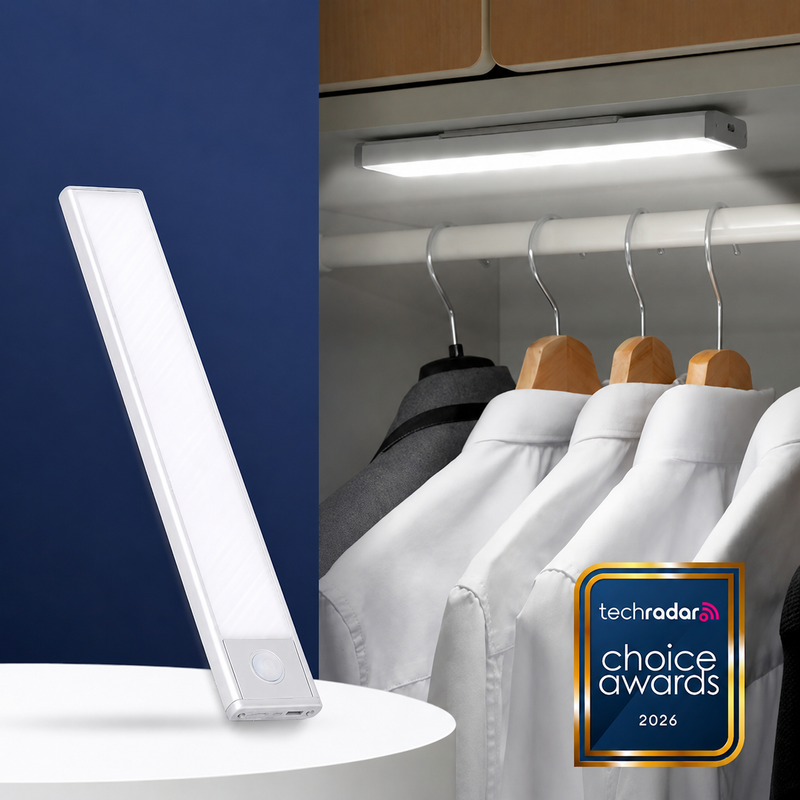
USB-C rechargeable motion light, 3 modes, peel-and-stick install.
From $12.99It detects infrared heat radiating from objects, particularly the temperature contrast of a warm body moving against a cooler background. It requires direct line of sight since infrared doesn't pass through walls.
Direct sunlight, HVAC vent airflow, pets, insects on the lens, and rapid temperature changes are documented causes. Repositioning or lowering sensitivity usually fixes it.
Pairing an ambient light sensor with the PIR makes a real difference — without it, daytime triggers can cut battery life roughly in half compared to a light that only activates in genuine darkness.
Enclosed, naturally dark spaces like closets — the thermal contrast is pronounced and the required detection range is short, both improving reliability.