Some trackers stop working without a monthly fee. Others don't. Here's how the business models actually differ, and how to check battery claims before you buy.
Not all fitness trackers are built the same way when it comes to cost. Some brands treat the tracker as hardware you own outright — pay once, use it forever. Others treat it more like a service: the device is effectively inert without an active monthly or annual membership. Neither model is inherently a scam, but the difference matters a lot for your long-term cost, and it's not always obvious from a product page alone. This guide breaks down what to actually check.
The range some subscription-model trackers charge per year just to keep the hardware functional.
The two dominant business models in this category, with real differences in long-term cost.
Independent full-tracking tests commonly report shorter battery life than brand-stated best-case figures.
Four things worth verifying before you buy — tap any card to expand.
This is the single biggest cost variable. Some trackers require an active membership for the hardware to function at all — cancel, and the device stops reporting most or all metrics. Others are a genuine one-time purchase, with core sleep, heart rate, and recovery data included free indefinitely, sometimes with an optional paid tier for extra features like deeper trend reports. Check this specifically before you buy, since it's rarely the headline of the marketing.
Brand-stated battery life numbers are typically measured under specific, often optimized conditions. Independent reviewers running continuous full-feature tracking (24/7 heart rate, sleep, movement) frequently report notably shorter real-world battery life. Look for independent hands-on reviews that specify their testing conditions, not just the number on the spec sheet.
Wrist-based optical heart rate sensors have well-documented, industry-wide limitations during high-intensity movement, especially strength training with a lot of wrist motion. This isn't specific to any one brand — it's a known limit of the sensor technology itself. If precise workout heart rate matters more to you than sleep and recovery tracking, a chest strap will generally outperform any wrist-based device.
Some trackers include a pattern-flagging feature for biometric changes (HRV, temperature, sleep shifts) marketed as early illness detection. Reputable brands are explicit that this is a wellness-monitoring tool, not a diagnostic medical device — check the fine print for this exact framing, since it affects how much weight you should put on any alert it generates.
| Factor | Subscription Model | One-Time Purchase |
|---|---|---|
| Upfront cost | Often lower device price | Higher upfront, no recurring fee |
| Long-term cost | Compounds annually | Fixed after purchase |
| What happens if you cancel | Device may stop reporting data | Core features remain functional |
| Advanced features | Usually included | Sometimes gated behind optional paid tier |
| Best for | Users who want the newest features continuously | Users who want to avoid recurring bills |
Almost every tracker in this category advertises multi-day battery life. In practice, real-world results vary a lot depending on which features you leave running.
Here's the honest testing gap: a brand's "up to X days" figure is often a best-case number, sometimes achieved with select features disabled. Independent reviewers who run full 24/7 tracking — continuous heart rate, sleep staging, movement detection — commonly report meaningfully shorter battery life than the marketed figure. Neither number is necessarily wrong; they're measuring different things. Look for reviews that specify exactly what was running during their battery test.
If all-day, every-feature tracking matters to you, budget for battery life closer to what independent full-tracking tests report, not the headline spec.
Hume Band 2.0 is one specific product in the no-subscription tracker category discussed above. We built a full, honest review that checks its real battery life against independent testing, and looks at how its blood pressure and workout heart rate features hold up under the same scrutiny.
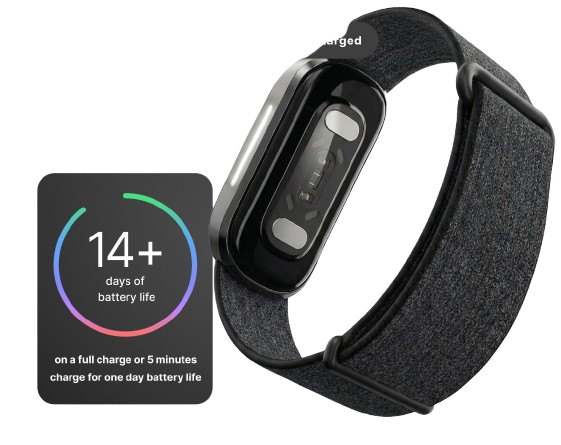
Real battery numbers, subscription model, and an honest FAQ.
No. Some trackers, like WHOOP, require an active membership for the hardware to function at all. Others are a one-time purchase with all core metrics included free, sometimes offering an optional paid tier for extra features. The business model varies significantly by brand, and it's worth checking before you buy, not after.
Brand-stated battery life is usually measured under specific, often best-case conditions. Independent reviewers running full continuous tracking (heart rate, sleep, movement, all features active) commonly report shorter real-world battery life than the marketed figure. Check independent hands-on testing, not just the spec sheet, if battery life matters to your decision.
Wrist-based optical sensors have known, documented limits during high-intensity activity, particularly strength training with a lot of wrist motion. Chest-strap sensors are generally more accurate under load. This is a known industry-wide limitation, not specific to any one brand.