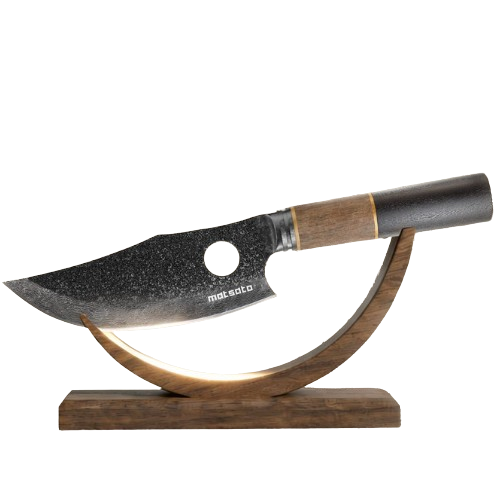
4CR14 stainless steel, cryogenically ice-hardened, paired with a full-tang beechwood handle — designed for the slicing, dicing, and trimming that fills most of your time in the kitchen.
Check Price
A knife's performance comes down to steel, geometry, and handle — Matsato is built around a Santoku profile: a gently curved body, flat edge, and tapered tip suited to the slicing, dicing, and trimming that makes up most kitchen prep time. The blade is 4CR14 stainless steel, put through a cryogenic ice-hardening step during manufacturing — a treatment many knives at this price point skip because it adds cost and time.
An honest note on this brand: "Matsato" is sold across a number of different websites with inconsistent specs (some list beechwood handles, others rosewood; some claim different steel grades). We've built this page around the specifications that appear consistently across the more credible sources — not the highest claim, the most repeated one.
Ice-hardened stainless steel, built for edge retention.
Secured with stainless steel rivets, shaped for a stable grip.
Curved body, flat edge, tapered tip for all-purpose prep.
Forging, hardening, grinding, polishing, and inspection stages.
Different tiers of kitchen knife, different trade-offs.
Specifications based on the most consistently repeated brand information across multiple sources. Always confirm exact dimensions and materials at checkout, since specs vary between resellers.
4CR14 stainless steel, cryogenically ice-hardened as part of the manufacturing process — a treatment step most knives in this price range skip.
Beechwood, secured to the full-tang blade with stainless steel rivets. It's shaped to fit the palm and stay comfortable through extended prep work.
A Santoku-style blade — a gently curved profile with a flat edge and tapered tip, suited to general prep work like slicing, dicing, and trimming.
Hand wash and dry immediately to prevent rust, and use a whetstone or honing steel for sharpening. Avoid dishwashers, which can dull the edge and stress the handle over time.
Traditional Japanese Santoku knives commonly sell for $100-200 or more. Matsato uses a similar blade profile at a lower price point — the trade-off is typically in the steel grade and hand-finishing compared to higher-end artisan blades.
Yes, the official store offers a 60-day return policy. Confirm the current terms at checkout before ordering.
See availability and current price at the official store before ordering.
Check Price